Donut
AI-assisted workflow tooling, design-system improvements, and redesigned employee-engagement surfaces for an Accel-backed SaaS platform.
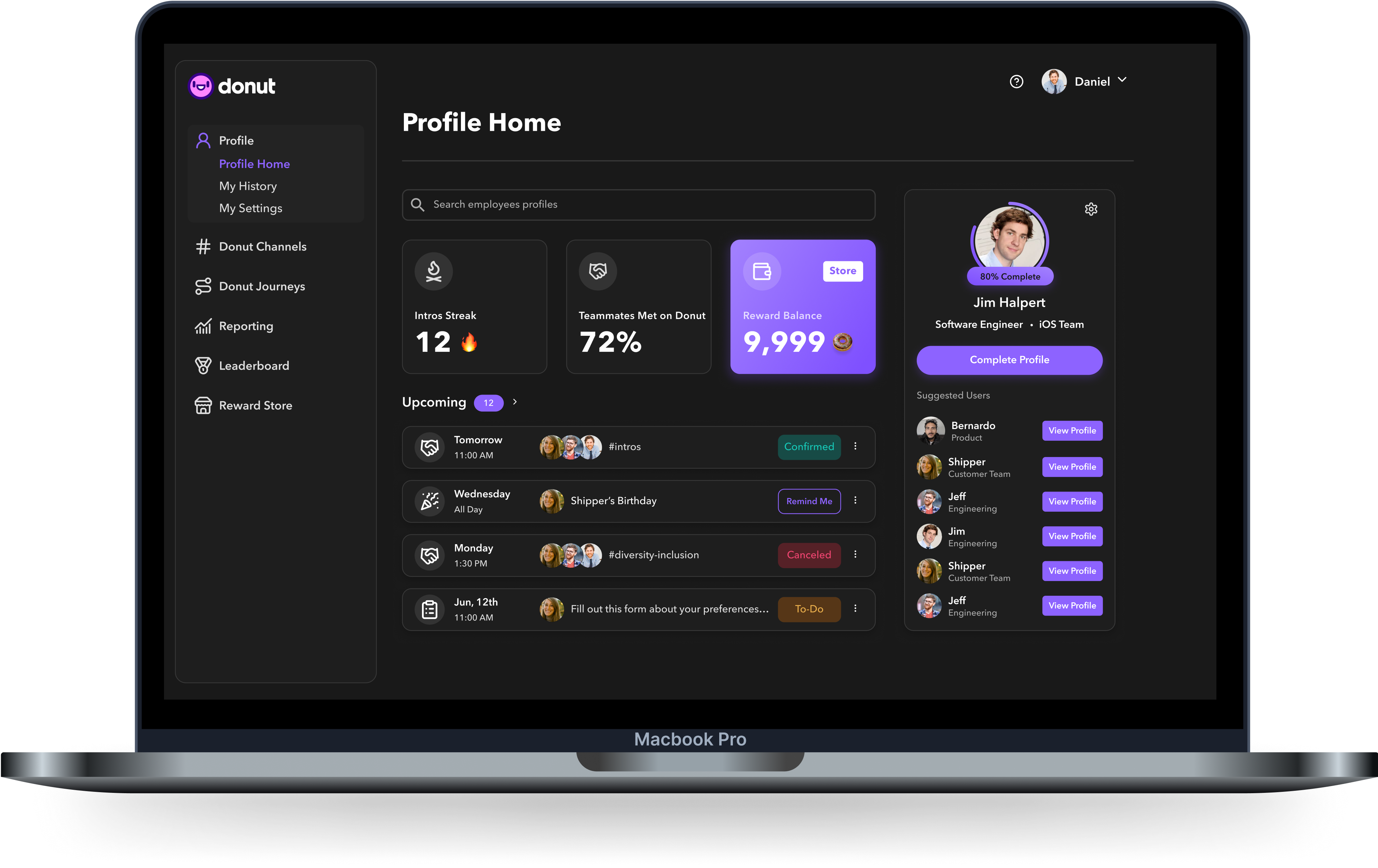
Donut is an Accel-backed SaaS platform that helps companies onboard, connect, and retain employees through automated programs and community-building tools.
I worked across research, product design, prototyping, frontend implementation, and design-system improvements, partnering directly with design leadership and cross-functionally with engineering, customer success, and the CEO.
Company Context
The product spans a Slack-integrated employee experience and a web dashboard for HR teams and admins.
That meant the work had to balance lightweight employee-facing interactions with more complex admin workflows for program setup, engagement, and measurement.
One of the bigger product opportunities was expanding Donut beyond lightweight engagement into more mission-critical people programs: onboarding, training, enablement, manager support, and other structured workflows that HR teams already have to run.
AI Journeys Builder
Journeys are automated people-program workflows made of scheduled Slack messages, polls, emails, channel invites, intro calls, and tasks. They can support onboarding, training, manager check-ins, buddy programs, policy rollouts, and other internal programs that are important but time-consuming to build manually.
Creating a new journey was powerful but slow. Admins had to schedule each action individually and write all the content themselves. Templates helped, but they were not specific enough to a company’s culture, tools, policies, or existing documentation.
I worked on the AI Journeys Builder as a way to bring those higher-value programs into Donut’s product offering. The flow let admins upload company context, select goals, generate a tailored journey, and review the recommended structure before turning it into an editable workflow.
I used FullStory analysis, internal testing, stakeholder reviews, and user interviews with customers to understand where teams got stuck and what they expected from an AI-generated journey. Those conversations shaped decisions around goal tagging, document intake, channel selection, generated copy, and how much control admins needed before trusting the output.
Design System And Storybook
Donut’s dashboard design system had accumulated inconsistent one-off components and unclear implementation patterns.
I helped refresh the system through reusable Vue components, a Storybook component site, improved accessibility, updated typography and spacing, and closer design-engineering handoff.
The Storybook work was important because the dashboard was being asked to support more complex product surfaces: AI setup flows, richer profiles, admin workflows, and more employee-facing pages. Documenting components, props, states, and usage patterns gave engineers a clearer implementation source of truth and made the redesigned surfaces easier to build consistently.
Profiles And Dashboards
Profiles and dashboards needed to become more action-oriented and engaging.
I redesigned and implemented surfaces that added profile completion prompts, actionable stats, suggested users, upcoming events, matching signals, and clearer paths into Donut’s core programs like Intros, Shoutouts, Celebrations, and Journeys.
Outcome
The AI Journeys work moved setup from a repetitive manual process toward a faster generated workflow. The design-system work gave the team a stronger shared implementation base, and the profile/dashboard work reframed static pages as active entry points into the product.